Research interests
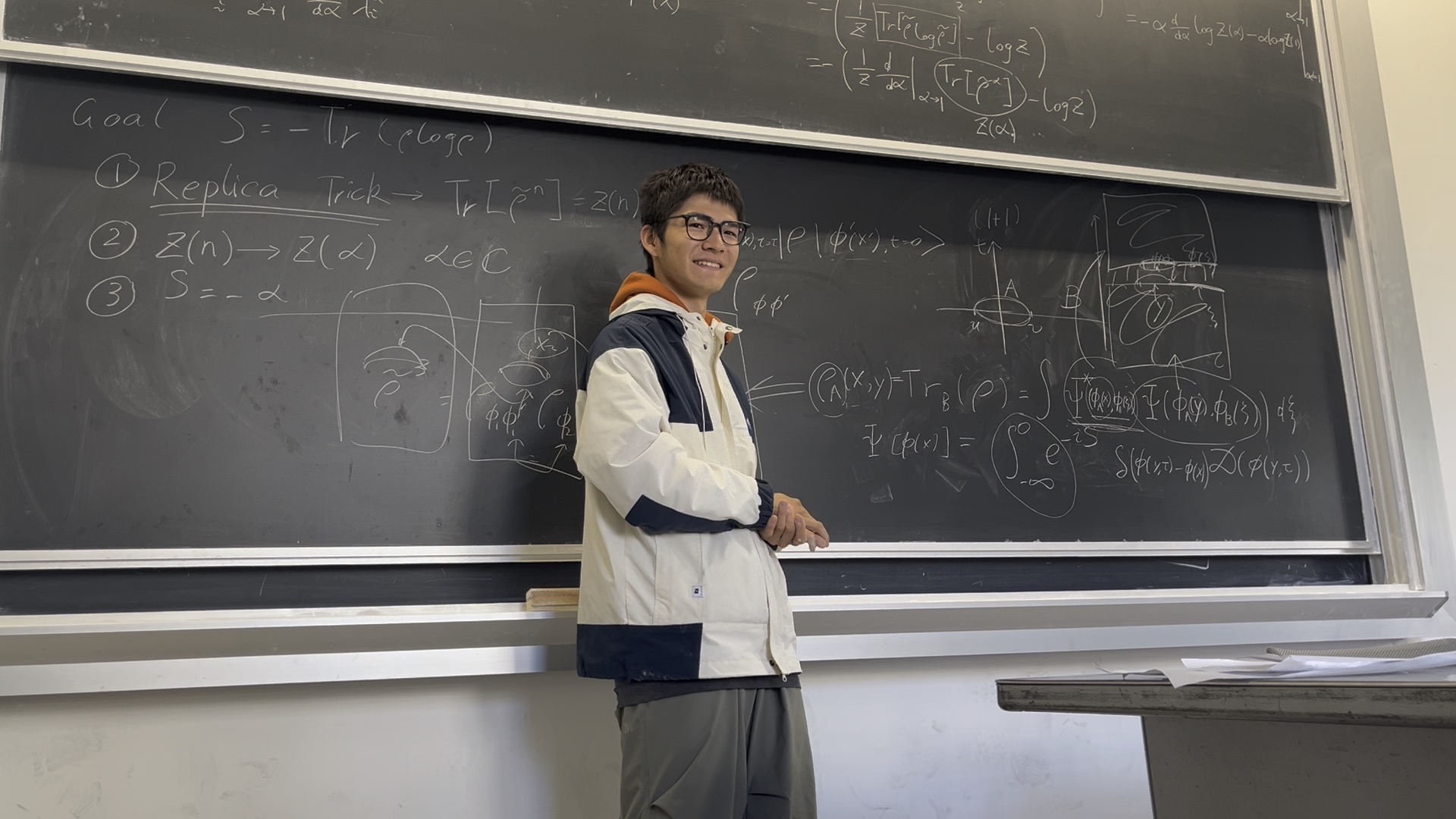
My interest in theoretical physics begins with wanting to understand nature and its beauty. To me, theory is a way to uncover the regularities of nature and, through them, the structure of the world. Questions about symmetry, symmetry breaking, and emergence continue to fascinate me.
I would like to grasp, and perhaps develop, mathematical structures that help solve concrete problems, and to understand the mysterious connections between different theories. Working through real problems from different fields should also give me a more visual understanding of the mathematical objects involved. The research I admire most starts from a phenomenon, abstracts a clearly stated mathematical problem, solves it, and returns to the phenomenon with an explanation.
Theoretical physics taught me to look for structures shared by very different systems, and I would like to bring that approach to neuroscience. I want to understand how connectivity and dynamics produce collective activity in a network, and how that activity supports learning, memory, and attention. I am interested in how the covariance spectrum, as a general tool, can help explain cognitive processes across experiments. Beyond that, I am curious about the neural basis of language and how the words we use shape the way we think. I would also like to see how the theory changes when I change the assumptions about nonlinear dynamics or connectivity.
For a fuller account of my background and research interests, explore my statement of purpose as an interactive map. Zoom out to see how the ideas connect, or zoom in to read individual passages and the original text. The map includes English and Chinese views, along with notes on questions I am still thinking through.
Research experience
Neural-activity covariance spectra
With Tianqi Xu and Quan Wen · School of Life Sciences, USTC · July 2026–present
- Studying the covariance spectrum of activity in random recurrent networks, including how finite sampling affects the spectrum.
- Worked through the calculation of recursive equations for the spectral distribution.
Phase-field modeling and droplet formation
Zhonghuai Hou's group · Department of Chemical Physics, USTC · December 2025–March 2026
- Simulated droplet formation with an existing MATLAB phase-field model, and compared the resulting patterns across parameters.
Monte Carlo calculations for simple models
Raúl Briceño's group · UC Berkeley · April–August 2025 · day-to-day mentor: Malcolm Lazarow
- Wrote Monte Carlo code for a harmonic oscillator and estimated its energy gap from a correlation function.
- Reproduced earlier results by reusing existing code, a quick route into understanding a physical problem.
Education
University of Science and Technology of China
Undergraduate in Physics · September 2023–present
University of California, Berkeley
Visiting Student, Berkeley Physics International Education Program · January–August 2025
Teaching
Teaching Assistant, Statistical and Thermal Physics
USTC · Spring 2026